Why Memorizing Music Is So Important

By Andrew Ingkavet

With all of my students, I stress the importance of memorizing their pieces, especially for performance at a recital. Here’s some of the reasons why.

Repetition is the Mother of Skill

How many times did Tiger Woods hit a golf ball before ever entering a competition? Apparently he was already golfing at age 2 when he made an appearance on the Merv Griffin show with his Dad. He turned professional at age 21 after winning many competitions along the way. That’s 19 years and probably 30,000 to 40,000 hours of practice! In Malcolm Gladwell’s book Outliers,  he discusses the theory that it takes an applied 10,000 hours of practice to mastery in any field. No wonder Tiger Woods is the greatest golfer that ever lived!  He’s simply played 3 or 4 times much as anyone else before he even turned pro!

Tiger Woods golfer
Now, I’m not demanding 8 hour practice days for my students, but five minutes the day before the lesson is just not going to cut it. It’s unfair to the student who is going to sound awful and not enjoy the wonderful process and sense of accomplishment of learning a song to a masterful level.

Technique

As we use our muscles to achieve the production of sound, we need to train them to move in specific ways. Fluidity can only be achieved by repetition. By consciously practicing the repeated motions at the same time being mindful of proper alignment of back, wrists, hands, we can create smooth, fluid motions that create beautiful sounds without repetitive stress injuries.

Practicing small bits at a slow speed can produce incredible, exponential results. When pianist Glenn Gould burst onto the scene as a young man, his flawless technique stunned the world, as did his ingenious interpretations of Bach.

Pattern Recipes

The bits of music phrases teach re-usable pieces of the fabric of music. Just like a recipe book or a code pattern that can be re-used in many projects, future songs will surely employ similar melodic, harmonic and rhythmic ideas. Music performance, composing and listening becomes easier as we progress. This is in fact the basic concept of object orient programming for computers. By designing a library of re-usable components, programmers can quickly put together new projects by cobbling together pre-build elements. Learning a later song is easier because the old one had similar patterns. And then, creating variations is now an option.

Artistic Expression

Spencer TracyThe famous actor Spencer Tracy was once quoted,

“Know your lines…and don’t bump into the furniture.”

You could say the same of music.  Know the notes.

How can you make the music your own without knowing it at a deep subconscious level.
When I was briefly an actor, I took a wonderful class in
the Meisner technique. The basic exercise was called the Repetition technique. It consisted of 2 or more actors on a bare stage with minimum set props. It was improvisatory in that each would only repeat what the other said until there was a natural impulse to say something else. What was amazing was that the inane conversation became full or emotion and life immediately as the words were not hindering the emotion. It’s the same thing in music. But, we need to know our parts. Of course, in jazz, improvisation is the raison d’etre, but there is still an agreed-upon structure.
We need to get to the very heart of emotion in the music, and the only way is to memorize, internalize, and interpret as our own. To know the music fully.

Tell A Story

To make your music tell a story, you need to have a physical comfort level with it. You can’t NOT know your parts. Otherwise it’s like the actor who doesn’t know his lines…you don’t believe them.

Instrumental Music is extremely abstract. Pop and folk songs with lyrics provide a narrative focus. But pure instrumental music can benefit in having some kind of narrative in that it can bring a piece to life. Make up a storyline for your piece! Sometimes this is relatively easy as the music is dramatic and narrative by nature.   Disney realized how Dukas’ Sorceror’s Apprentice was perfect in that it told the story.  Take a look.

I’ve been astounded by the difference in performance by some of my youngest students when they add a storyline to their piece. What’s even more amazing is that 6 year stories are all pretty much the same! But the music sparkles!

Repertoire

Having a mind full of pieces to perform at a moment’s notice is a wonderful thing. It’s what makes one feel like a truly accomplished musician. And, you never know when your Aunt Harriet is going to pop over with her friends and ask you to play “something sweet.”

How Memory Works

So how does memory work? Scientists still know only a fraction of how the brain works, but we’re learning more everyday. There is still so much research still to be done. 

So far, it seems that there are some generally agreed-upon concepts.

Encoding – getting the information into your memory. Of course, the information needs to be right from the start. Garbage in does equal garbage out.

Storage – There’s short term and long term. It seems we are similar to computers in that we have temporary space for short term and commonly used information. If we don’t use it, we lose it, unless we consciously store it in an organized way.

Retrieval- Getting the right information out when you want it is possibly the trickiest. Many scientist believe that the human mind never forgets anything, it’s just difficult to retrieve on command. But, repeated retrieval places the keys to a specific memory in a prominent location. So if you want to remember where you put your keys, try saying it aloud when you put them down. And, practicing your piece on your instrument at repeated intervals is like oiling the doors to that memory closet.

How To Memorize Music

In a famous study done by George Miller at Princeton University they discovered that humans can memorize up to 7 discreet bits of information, plus or minus 2. But chunking this into groups greatly increases the amount that could be stored and retrieved easily. We can apply this to music memorization.

Chunking It Down

To start memorizing, I suggest with a small chunk or part, perhaps even as little as 3 to 4 notes. The younger the student, the less notes. As they learn, we can go to the next chunk, and after mastering and memorizing that, we group those two chunks together. By continuing to add to the memory in small groups, and then synthesizing those into a larger whole, the entire piece can be memorized quickly so that a piece with several pages can be played from memory easily.
Some common breakpoints would be first measure, then second measure, then group them together. Then do the next 2 measures that way before you group together the entire first stave. Then A section can be memorized as contrasted to B section, etc.

Listening

An extremely effective way of learning a new piece is by listening to an existing recording. This is, of course, the bedrock of the Suzuki program of music instruction.

At higher levels, this may influence the styling of the performance, but that’s why we listen to great performances! Better to mimic the masters. You can also record yourself playing the piece slowly to listen to it over and over again.

Writing as a Memory Aid

Hand-written music by Mozart

Hand-written music by Mozart

Actors learning lines often write and re-write their lines without punctuation, like a long run on sentence. Why no punctation? By learning the words as raw material, they can add their own punctation depending on the emotion required for the scene. We can do the same for music, though the punctuation is usually dictated by the composer in terms of tempo, dynamics and accents, etc. By copying the music to staff paper, another method of input has been created both visual, kinesthetic and even aural through mental memory of the sounds. As a composer, I’ve gained invaluable details and nuances by just copying pieces of music. The physical act of copying does something that internalizes into the mind and body. It’s why the great painters all learned by copying the masters at the Louvre.

Blind Memory

Another technique to memorize is by relying on the auditory, and kinesthetic only. By blindfolding, or closing one’s eyes, or even turning out the lights, the musician can practice

Ray Charles

Ray Charles

without relying on the visual and play by touch and ear. This will also make the student realize quickly if they are not committing to a fingering pattern as they will be unable to play it blind. And, some of the best musicians in the world were literally blind.

Visualization

I’ve heard of stories where prisoners of war without access to their instruments practice completely in their mind, visualizing the experience completely, hearing it in their mind’s ear and seeing themselves in the mind’s eye performing their piece perfectly. These people return from their isolation playing better than before! I’ve told a few of my students about this and you can see in this video, my student Mitra is actually visualizing herself right before she performs onstage. Wonderful!

My son Alejandro has been working on a difficult piece by Bach and he recently told me that every night before he goes to sleep, he visualizes himself performing this piece. Wow! I don’t even recall telling him to do this!

An Odyssey, A Memory Palace

There’s a lot of wonder at how some of our ancestors could remember stories to pass on to the next generation. One was was through the use of rhythm and sound in the form of poetry, a kind of word music. By linking the sounds with the imagery in the stories, whole long passages could be told and memorized. By singing the melodies of the piece you are trying to memorize, you are using these very techniques and internalizing the music. Glenn Gould would sing all his parts incessantly to the point where he never stopped singing even when performing in public or recording his piano pieces.

There’s also the technique called the Memory Palace, where using the memory of a physical place you know intimately such as your own home, you could “store” information in specific locations. So, to remember things in a specific order, you could then mentally walk through your palace and retrieve the information. I found this book where it taught me all the names of every play by Shakespeare in the proper order, and lo and behold, it works! Now I should really do this for something more useful like song lyrics as I’m terrible at remembering them.

The Benefits of Memorization

Now the greatest thing is that these memorization and learning skills are applicable and transferrable to the rest of your life, forever! You can use them to learn anything like languages, careers, work stuff, school, research, anything! You are basically learning to operate your mind. How to store information, keep it fresh, retrieve it when you need it and then use it to combine, build, mix, remix and synthesize all you want. And to think you got all this from memorizing your little recital piece!


Winter 2013 Music Recital Videos

Piano Lessons For Kids in Park Slope, Brooklyn

Winter 2013 Music Recital

We had a lovely Winter Recital on Saturday at the Park Slope Library here in Brooklyn, NY.  Though there was a scheduling mix-up and we almost had to cancel, it all turned out well in the end.  Thanks much to all at the Brooklyn Public Library especially Leane and John who worked it out.

I’ve posted a playlist of all the videos on our YouTube channel, but here’s a few below.

Amalia:

Alejandro:

Photos from our first Music Salon

Music Salon at Minovi House

Sing along with us!

I had this idea to have more public performances for my students which was well received by all the parents.  This afternoon, we had our first Music Salon, hosted by Maziar & Michelle, and it went wonderfully!  It was a casual festive event with wine and snacks and a roaring fire with a great 13 foot Christmas tree.  Just lovely.   And we had a sing-along of some Christmas favorites.  The best part was that some of my shyest and quietest students  got up to play several times and all did a great job.

Here’s some photos from the event.  And many many thanks to Maziar and Michelle for being such gracious hosts.

Cincopa WordPress plugin


Music Practice As A Discipine For Life

I read this great article about how music lessons became a great discipline for success in life.  What really resonated with me was the fact that none of the writer’s 4 daughters were natural “prodigies” and had to struggle with daily music practice.  I too did not just fall into playing piano and guitar and alto saxophone.  But once I found my favorite teacher(s) and repertoire it started to flow easier.

Flash-forward 20 years from that first Suzuki lesson, and three of my four kids have put away their violins in favor of other pursuits. But those early lessons stuck. All four have had the courage to embrace long-term, large-scale projects outside the realm of their formal academic training. All of them credit their Suzuki days for ingraining in them the habit of patient practice that has seen them through the long, slow development of mastery.

Sure, talent matters. Talent is the difference between good art and great art, between proficiency and virtuosity. But talent alone is rarely enough to get by.

See the whole article here at Philly.com


Teaching Kids How To Read Music Using Solfège, Hand Signs & Kinesthetic Learning

Teaching young kids to read music is quite a challenge.  I approach through a long process of micro-steps.  It’s the reverse of peeling an onion.  It’s a layering technique of building up from tiny kernels of understanding, expanding outwards.

The first lessons are always performance focused – get them excited about playing a song!  It’s fun and within reach to play a song in 5 minutes!  That is so awesome!

Then over the course of many lessons, we explore basic concepts of music theory through a series of games.  One of these “games” is learning solfeggio (Italian pronunciation), also known as solfège (French pronunciation).  This is the system of pitches with words that was created in the eleventh century by a Benedictine monk, Guido de Arezzo.

To make it easier, I always look for ways to engage other learning modalities besides visual or aural.  In this case, an Englishman by the name of John Curwen did this work in the 1800s by creating a system of hand signs to go with the solfège system.   This engages the brain to have another way of remembering these pitches.  Kids love it and it certainly is fun!

Another great educator (and composer) the Hungarian Zoltan Kodàly took these hand signs and made it easier by associating a height with each sign to correlate the rising of the pitch with each syllable.

In my lessons, I teach my students using 2 hands to make it even easier as it balances both left brain and right brain.  Plus it’s easier and more fun!  Did I mention that fun is important?

I created a printout for my students that features…them(!) – to help remember these.

Learning Solfege with Curwen Hand Signs

Solfege is fun!


Hopefully we’ll all be singing and signing at our next recital.

Here’s a video from another teacher (who also produces wonderful educational tools which I use and heartily recommend.)

After internalizing these pitches and then connecting them with notes on the staff, reading music becomes connected with the aural, visual and kinesthetic.  It has become much easier to move into any standard method book after a few weeks of this.


How to Play London Bridge on the Piano

I’ve started making videos of songs I’m teaching my students as so many of them are visual learners and have the technology to view this at home.  This video is not meant to be a step by step instruction but a reinforcement/memory aid for after the lesson when practicing at home.

The Everlasting Positive Effects of Music Lessons

It seems every year there’s a new study that confirms the positive benefits of music lessons in early childhood.  This one has some great findings:

From the NY Times Well Blog:

By PERRI KLASS, M.D.

Joyce Hesselberth

When children learn to play a musical instrument, they strengthen a range of auditory skills. Recent studies suggest that these benefits extend all through life, at least for those who continue to be engaged with music.

But a study published last month is the first to show that music lessons in childhood may lead to changes in the brain that persist years after the lessons stop.

Researchers at Northwestern University recorded the auditory brainstem responses of college students — that is to say, their electrical brain waves — in response to complex sounds. The group of students who reported musical training in childhood had more robust responses — their brains were better able to pick out essential elements, like pitch, in the complex sounds when they were tested. And this was true even if the lessons had ended years ago.

Indeed, scientists are puzzling out the connections between musical training in childhood and language-based learning — for instance, reading. Learning to play an instrument may confer some unexpected benefits, recent studies suggest.

We aren’t talking here about the “Mozart effect,” the claim that listening to classical music can improve people’s performance on tests. Instead, these are studies of the effects of active engagement and discipline. This kind of musical training improves the brain’s ability to discern the components of sound — the pitch, the timing and the timbre.

“To learn to read, you need to have good working memory, the ability to disambiguate speech sounds, make sound-to-meaning connections,” said Professor Nina Kraus, director of the Auditory Neuroscience Laboratory at Northwestern University. “Each one of these things really seems to be strengthened with active engagement in playing a musical instrument.”

Skill in appreciating the subtle qualities of sound, even against a complicated and noisy background, turns out to be important not just for a child learning to understand speech and written language, but also for an elderly person struggling with hearing loss.

In a study of those who do keep playing, published this summer, researchers found that as musicians age, they experience the same decline in peripheral hearing, the functioning of the nerves in their ears, as nonmusicians. But older musicians preserve the brain functions, the central auditory processing skills that can help you understand speech against the background of a noisy environment.

“We often refer to the ‘cocktail party’ problem — or imagine going to a restaurant where a lot of people are talking,” said Dr. Claude Alain, assistant director of the Rotman Research Institute in Toronto and one of the authors of the study. “The older adults who are musically trained perform better on speech in noise tests — it involves the brain rather than the peripheral hearing system.”

Researchers at the University of California, San Francisco, are approaching the soundscape from a different point of view, studying the genetics of absolute, or perfect, pitch, that ability to identify any tone. Dr. Jane Gitschier, a professor of medicine and pediatrics who directs the study there, and her colleagues are trying to tease out both the genetics and the effects of early training.

“The immediate question we’ve been trying to get to is what are the variants in people’s genomes that could predispose an individual to have absolute pitch,” she said. “The hypothesis, further, is that those variants will then manifest as absolute pitch with the input of early musical training.”

Indeed, almost everyone who qualifies as having truly absolute pitch turns out to have had musical training in childhood (you can take the test and volunteer for the study at http://perfectpitch.ucsf.edu/study/).

Alexandra Parbery-Clark, a doctoral candidate in Dr. Kraus’s lab and one of the authors of a paper published this year on auditory working memory and music, was originally trained as a concert pianist. Her desire to go back to graduate school and study the brain, she told me, grew out of teaching at a French school for musically talented children, and observing the ways that musical training affected other kinds of learning.

“If you get a kid who is maybe 3 or 4 years old and you’re teaching them to attend, they’re not only working on their auditory skills but also working on their attention skills and their memory skills — which can translate into scholastic learning,” she said.

Now Ms. Parbery-Clark and her colleagues can look at recordings of the brain’s electrical detection of sounds, and they can see the musically trained brains producing different — and stronger — responses. “Now I have more proof, tangible proof, music is really doing something,” she told me. “One of my lab mates can look at the computer and say, ‘Oh, you’re recording from a musician!’ ”

Many of the researchers in this area are themselves musicians interested in the plasticity of the brain and the effects of musical education on brain waves, which mirror the stimulus sounds. “This is a response that actually reflects the acoustic elements of sound that we know carry meaning,” Professor Kraus said.

There’s a fascination — and even a certain heady delight — in learning what the brain can do, and in drawing out the many effects of the combination of stimulation, application, practice and auditory exercise that musical education provides. But the researchers all caution that there is no one best way to apply these findings.

Different instruments, different teaching methods, different regimens — families need to find what appeals to the individual child and what works for the family, since a big piece of this should be about pleasure and mastery. Children should enjoy themselves, and their lessons. Parents need to care about music, not slot it in as a therapeutic tool.

“We want music to be recognized for what it can be in a person’s life, not necessarily, ‘Oh, we want you to have better cognitive skills, so we’re going to put you in music,’ ” Ms. Parbery-Clark said. “Music is great, music is fantastic, music is social — let them enjoy it for what it really is.”


What Music Should My Child Be Listening To?

A Playlist for Young Music Students – or anyone who appreciates a wide eclectic listening palette.

I hope you are having a super summer and getting some much needed recharging.
As you know, listening to quality music is one of the most important parts of being a music student. Hearing comes before sight as well as our ability to talk.  Music is a language and the more your child listens to a wide variety of quality music, the wider your child’s view of the world. With that in mind, I wanted to let you know of an amazing resource called Spotify.  If you didn’t already know, this a free software app/website that allows you to listen to about 90% of all recorded music for free - http://www.spotify.com.  It’s like an internet radio station/library.

This is an amazing resource for teachers, students and fans.  There are a few commercials, but you can pay for a premium version without commercials – which is how the musicians and composers get paid by the way.  The best part of Spotify is the social aspect in that you can easily share songs and playlists with friends…and my students!

I’ve made an Essential Listening Playlist for my students.
It covers folk, jazz, blues, rock, bluegrass, country, film soundtracks, Colombian rock including one vallenato and some classical.  It’s quite eclectic, and is chosen for quality of music, composition, styles and appropriate lyric content.  You will never hear this on commercial radio – no Justin Beiber here!  Once you subscribe to this list, you’ll receive updates as I add them, so in effect, I’ll be your DJ.

Here’s the link to my Essential Listening for Students:
http://open.spotify.com/user/andrewingkavet/playlist/3svXAAcxEcOrgc5V2HRSgJ

So set up your family computer, iPod, iPhone or smartphone with Spotify and enjoy!

Summer 2012 Music Lessons still available

If you are interested in piano, guitar, strumstick, ukelele, voice, songwriting and music theory lessons this summer, there are still slots available.  The summer lesson schedule runs 6 weeks from July 9 through August 16 Monday through Thursdays.  There are morning and afternoon sessions.  Lessons are $60 each or $330 for the full 6 weeks.

Contact me if you are interested.

Play Piano For Kids, Volume 1 iPad interactive book app is now available

An interactive iPad book for young children with their parents, caregivers

Available now at the Apple App store

As many of you know, I’ve been working hard on an interactive iPad iBook for quite some time.  Today Play Piano For Kids, Volume 1 (Penguins Don’t Play Piano, But You Can!) is officially live in 32 countries around the world in the Apple iTunes Bookstore.  It’s on sale for the next week for only 99 cents after which it will go up to $6.99.  Pleases go and take a look and give a review/rating.

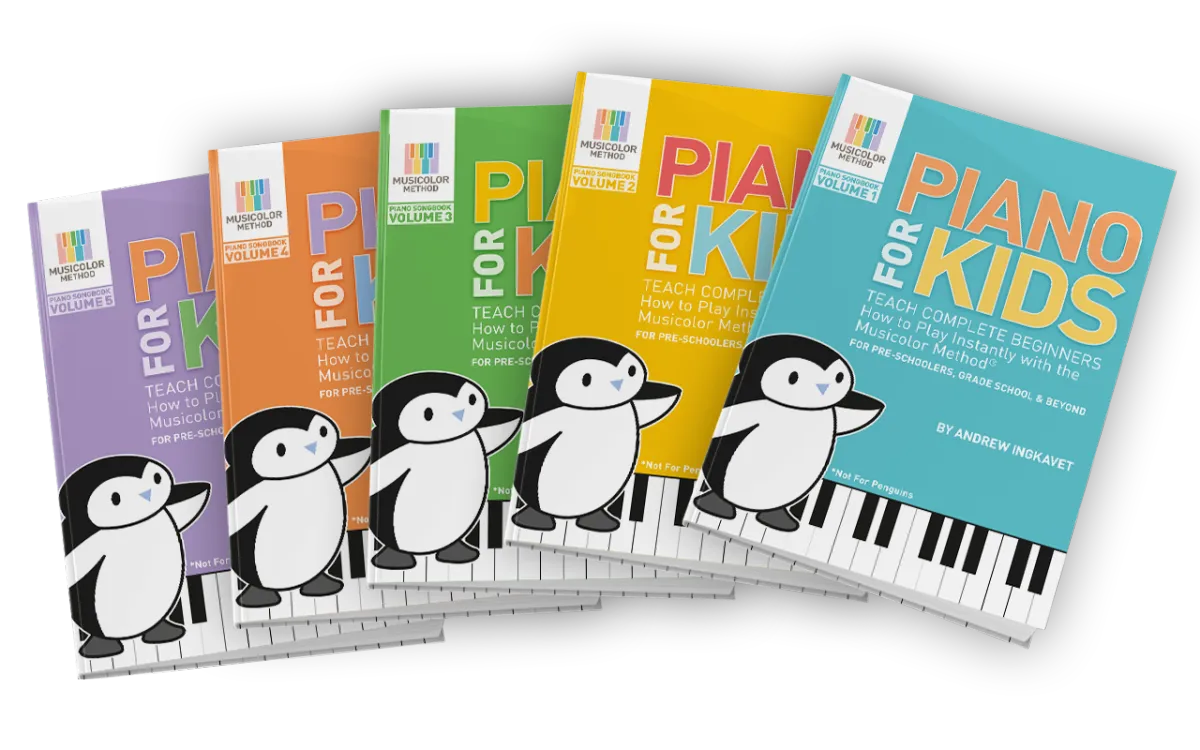
Aimed at parents , home-schoolers and teachers of young children aged 3 to 6 years old, the book is really an app which delivers a learning system including audio, video, animations and my unique color system.  It spans the first month and a half of lessons that in my private lessons would cost over $200!   There is no experience required and no need to read traditional music notation.  In fact, the problem with most music books and teachers try to present too much information at once.  By breaking down the learning process into micro steps, I’ve helped hundreds of kids learn to play piano, (and guitar) whilst having proper technique, and learning music theory, traditional notation and even composition.

For those of you who have been unable to get on my roster, this is a great way to virtually start lessons with me.  There’s even a free sample that gives you the first lesson for free.  And this is just the beginning, I’m already working hard on the next volume as well as a support website PlayPianoForKids.com

Feel free to comment!


Winter Recital 2012 Success!

It was a great recital last Saturday at the Carroll Gardens Library in Brooklyn.  With 30 students performing and a house of over 100 guests, we had a lovely time and everyone did their best.  Thanks again to all the parents, grandparents, friends and family who came to show their support, love and appreciation of our young performers!  And special thanks to Jeff Schwartz and the entire staff of the Carroll Gardens library who graciously let us use their space and even set up the chairs for us!


Here’s some photo highlights.  Videos are posted here.

Students warm up before the music recital

Students warm up before the music recital

Music Students of Park Slope Music Lessons

Lining up to receive award certificates

Giving out awards

Everyone comes onstage

Students at Winter Recital 2012

Winter Recital 2012

Strumstick student Felix

4 year old Felix on Strumstick

Evan & Sienna perform What A Wonderful World

Evan & Sienna perform What A Wonderful World

Ryan performs Katy Perry's Firework

Ryan performs Katy Perry's Firework

Ava performs Lightly Row

Ava gets prepared to play Lightly Row

Stella & Tellulah perform Adele's Someone Like You

Stella & Tellulah perform Adele's Someone Like You


A Typical Music Lesson – My Approach to Teaching

4 hands are better than 2!

Apologies for the site being down all of last week.  But we’re back!  Here’s a quick update and enjoy the week off for Thanksgiving!


As many of you know, in each of my lessons, my aim is to address 3 main areas: repertoire, reading and music theory.

Repertoire

This is building up a collection of pieces that your child can play from memory and perform in public.
It allows us to work on technique and bring music to life whilst giving a great confidence boost and joy in playing. This material I often present using my own color notation which enables your child to learn a piece as quickly as possible and then memorize it. Many of you are using Suzuki material for this repertoire whilst others are working on a combination of Suzuki with jazz, blues, pop and world music.

Reading

To  learn to read music is truly a great skill. To be musically literate opens a whole door to deeper appreciation. Reading music is not as difficult as it seems, but requires a steady practice diet.   I will usually not start this until we’ve been playing a repertoire of about 7 to 10 songs.  I use a proprietary method of notation to get them up to speed quickly with simple and then complex pieces.

Music Theory

This is the nuts and bolts of music. We get under the hood and see how music is structured and built through games, exercises, composition, dictation and listening.  It makes music fun if you know the how and why. It also changes your listening and deepens your appreciation of music. It can be quite abstract at times which is why we have many many activities and games built up over a long period of time.

Listening

I realize not everyone has a massive music collection at home and I’m often asked, “What should we be listening to?” I’ve recently written a series articles for Jill Simeone’s lovely parenting blog Cozy Owl which address, Early Childhood Music, Essential Listening and Music for A Road Trip.

In the near future, I’m hoping to post playlists of Music Every Child Should Hear via this site.


NOTE: Winter Music Session

The winter music session is starting on Monday November 28 and will run until February 11.  I will be sending out invitations for the limited openings available to those on the waiting list.   If you would like to join the waiting list, please go to the contact page and click the link.

Why Music Recitals Are Like Life Skills 101

Or things I wish I knew when I was 8 years old…

We had such a great recital last Saturday and it made me think of how important these events are for so many reasons.
Spring Recital 2011

Deadlines

Recitals are like so many things in life. It’s a due date when you need to really know something well and you need to show it in public, in this case 100 of your friends, families and peers. Think of the times when you had to present a paper or a case or a sales pitch at a specific time and day. The recital is preparation for that. It’s a deadline.

Discipline and Mastery

Preparing for the recital is also like life. The discipline required to learn, memorize and perform the pieces is the same discipline you use when you are in college working on a term paper, at your job preparing the big powerpoint presentation to your clients, presenting your court case to the judge and jury and so on. There’s a level of mastery that needs to be achieved in a recital. Nowadays, it seems there’s less encouragement or paths to mastery with all the instant gratification of digital downloads and games and apps. We don’t let our children go 5 seconds before we step in to help them with a frustrating problem. Mastery requires discipline and a commitment to “do it again…and again.” Self-help guru Anthony Robbins speaks of the 10,000 hours it required to master a skill. Malcolm Gladwell describes some great outliers including Bill Gates in Outliers: The Story of Success. It does take a lot of time, discipline and repetition to master anything. And music lessons culminating in a recital is a training ground for discipline on the road to mastery.  Even better to start at such an early age!

Memorization

In my past life as an actor and television host, I had to memorize lines all the time. I remember this as an incredibly difficult task. My acting teacher gave us the trick of writing down the lines over and over to internalize them. And then to say them back in multiple different rhythms and phrasing. Along the way, I started to notice certain patterns in the language and even structural groupings of how one paragraph was almost like a variation on a previous one. We’ve done many of these things in the music lessons as I ask my students to play the second part first, or play it at triple speed and then play it with your eyes closed and then play it as if you were dancing. And then somewhere around the 100th time, the notes stop being just a sequence of sound events, but they start to flow and have a feeling of their own. “It’s like I wasn’t even thinking about it anymore.” is the phrase I’ve heard from several of my students.

Music lessons for children in Park Slope Brooklyn

Warming up before the show

Performance Anxiety

Anxiety is a big part of any public performance. There was a survey somewhere I saw that listed people’s top fears in order of worst to least. At the top was public speaking, followed by death by burning! Incredible. Most people would rather die burning at the stake than have to speak in public. A recital is a public performance and by repeatedly going through the process, the anxiety lessens over time. 2 years ago, I remember a number of students in particular looking rather ill before their turn. Now, those same kids are still nervous, but it’s not the same panic attack level, rather a heightened level of awareness with a confidence that they will fly through.

Music lessons for children in Park Slope Brooklyn

A sing-a-long with Ava

Mistakes

Mistakes will happen as in life. In fact, how often do things go exactly the way you want them to? Almost never. Your goal is to minimize them. But you can never achieve 100% perfection, you wouldn’t want to. To play like a machine is completely useless. It’s the mistakes that make you sound human and gives you unique expression. As described in a recent NY Times article about what makes music so expressive, researcher Daniel J. Levitin at McGill University and Edward W. Large at Florida Atlantic University recorded a concert pianist performing a Chopin etude analyzing it for speed, rhythm, loudness and softness. They then recreated the performance with a computer stripping it of any human variances, in other words, making it more perfect. They then scanned the brains of listeners as they listened. The results? Perfection is boring.

Patterns

Another thing discovered by these researchers is that music can give us emotional hits by creating a subtle change from a pattern. In all of my lessons, I’m always showing the structure lying underneath the piece of music we are working on. Whether it’s the grand scheme of section A followed by section B or even just how the notes of one measure actually are spelling out an F chord. It’s the same in real life. There’s an order and structure to how things are put together, whether it’s a sandwich, a computer program, a resume or a social network.

Music lessons for children in Park Slope Brooklyn

Congratulations

Feedback

Possibly the best part of a recital is the immediate feedback from the audience. There’s no waiting around for an acceptance letter in the mail, if you did well, you know it right now! And if not so well, then you know that too. What’s great about our recitals is they are safe space, a controlled environment as everyone is there rooting for you. It’s your home court and we all want you to make a slam dunk! And if you don’t, we’ll empathize with you and give you a hug too. It really doesn’t matter – you did your best. And there’s always the next recital.

View videos from the Spring 2011 music recital.


Music lessons for children in Park Slope Brooklyn

Summer Music Lessons

This summer, I’ll be teaching a 5 week session from July 5 through August 6.

If you are an existing student and would like to continue at your regular time, please let me know ASAP.   I will be teaching private 30 minute lessons and, if enough interest, small group lessons of not more than 3 students.

The cost for the summer private sessions is $260 275, and the small group classes will be $$125 at a time to be determined.

Ages 3 and up.

I have a waiting list of students and will be making calls and emails this week.  If you would like to sign up, please do so here.


Spring Recital 2011 is June 11 at Carroll Gardens Library

We’ll be hearing the great work your children have been doing on Saturday June 11 at 3pm at the Carroll Gardens Public Library.  I’ll be there from 2:30pm to set up the room.  If you can, please come early to help and to let your kids get acclimated and to calm down any last minute nerves.

It’s free and open to the public, so invite your friends and family.  It’s also a good time to see the great resources of your local public library system – please support them!


Glenn Gould’s Finger Tapping Exercise for Piano Technique

Many of you are struggling with playing cleanly and smoothly. This simple technique can help you to relax your fingers to pay more fluidly. Developed by Glenn Gould’s mentor and longtime teacher Chilean pianist Alberto Guerrero, it aims to retain a relaxed muscle memory. You can learn more about this in the wonderful documentary Genius Within: The Inner Life of Glenn Gould.

Winter Music Recital 2011 – Pictures and Video

Winter Music Recital 2011 at Carroll Gardens Library

What a great success our Winter Music Recital was last Saturday!  I hope you all celebrated the great achievements of your children.  No matter if they played some notes that were not intended, the entire process of going on stage, in public, in a crowded room of at least 80 people, and performing the piece they practiced for months – priceless!

I noticed many parents who were much more nervous than their children!  And, by starting your kids early in this process of focus, practice and performing publicly, you’ve started them on the road to success in life no matter what professional path they choose.  And the benefits of developing an appreciation for beauty, form, structure and communication through music is why I do what I do.  I love teaching your kids and thank you for supporting us on our journey!

You can see more photos on Flickr and here’s our YouTube Channel.

Below are some of the videos on YouTube.

Jan 22, 2011 Winter Music Recital

We’ll be having our recital at the Carroll Gardens branch of the Brooklyn Public Library on Saturday, January 22, 2011 at 2pm. The space looks nice and they even have a grand piano – though so out of tune it is unusable!

It’s located at the corner of Clinton and Union Streets.  The recital, as always, is free, and open to the public, so come early to guarantee a seat and to help me set up the room!  I appreciate your help in putting away the chairs afterwards as well.

So we continue our tour of the Brooklyn Public Library spaces as weekend hours have been cut at Pacific Library and Park Slope is still under renovation for another year! Please support your/our public library!
Brooklyn Public Library - Carroll Gardens branch

Winter Semester for Music Lessons

The Fall semester is fast coming to an end with the last lesson on Saturday November 20, 2010. We’ll have a break for Thanksgiving with the new Winter session starting Tuesday November 30, 2010 and running until Saturday February 19, 2010.

The cost for the new semester is $550 with an early bird discount of $50 if paid before November 15, 2010.

There will be no lessons the week of

* December 24 – January 2 – Winter Holiday Recess

If you are not currently studying with me, space is extremely limited, but you may register on the waiting list here.

How To Read Music: Rhythm using Stick Notation

When teaching to read traditional music notation, I separate the 2 parts of pitch and rhythm.  Rhythm is easy to teach using stick notation.

[update-12-3-12] Stick notation is taking traditional notes and removing the note-head.  The note-head is the round dot at the bottom of the stick.  The dot is placed on the 5 lines of the staff and depending on where it is, tells us which pitch to play.  By removing the note-head, we focus only on the rhythm.

The use of hand movements, words and sounds enable us to get the music in our body, mind, eye and ear.  Multiple modes of experience!

This method is created by Michiko Yurko and you can find her and her books/games/workshops at MusicMindGames.com.

Here’s a little video I made with the help of Ava.